Genetically modified organisms - unnatural selection
Evolution and the environment
Showing posts with label science. Show all posts
Showing posts with label science. Show all posts
Tuesday, June 24, 2008

Wednesday, June 18, 2008
Genetically Modified (GM) food
here are some useful links to articles on gm food:
Harvest of Fear
GM food: Monster or Saviour
some links to videos on gm food:
GM: a solution for Africa
GM needed to fight banana wilt
Harvest of Fear
GM food: Monster or Saviour
some links to videos on gm food:
GM: a solution for Africa
GM needed to fight banana wilt
Tuesday, June 17, 2008
What are biofuels?
the following article is taken from http://news.bbc.co.uk/1/hi/sci/tech/6294133.stm
Biofuels are any kind of fuel made from living things, or from the waste they produce.
This is a very long and diverse list, including:
wood, wood chippings and straw
pellets or liquids made from wood
biogas (methane) from animals' excrement
ethanol, diesel or other liquid fuels made from processing plant material or waste oil
In recent years, the term "biofuel" has come to mean the last category - ethanol and diesel, made from crops including corn, sugarcane and rapeseed.
Bio-ethanol, an alcohol, is usually mixed with petrol, while biodiesel is either used on its own or in a mixture.
Pioneers such as Henry Ford and Rudolph Diesel designed cars and engines to run on biofuels. Before World War II, the UK and Germany both sold biofuels mixed with petrol or diesel made from crude oil; the availability of cheap oil later ensured market dominance.
Ethanol for fuel is made through fermentation, the same process which produces it in wine and beer. Biodiesel is made through a variety of chemical processes.
There is interest in trying biobutanol, another alcohol, in aviation fuel.
Are biofuels climate-friendly?
In principle, biofuels are a way of reducing greenhouse gas emissions compared to conventional transport fuels.
Burning the fuels releases carbon dioxide; but growing the plants absorbs a comparable amount of the gas from the atmosphere.
However, energy is used in farming and processing the crops, and this can make biofuels as polluting as petroleum-based fuels, depending on what is grown and how it is treated.
A recent UK government publication declared that biofuels reduced emissions "by 50-60% compared to fossil fuels".
Where are biofuels used?
Production of ethanol doubled globally between 2000 and 2005, with biodiesel output quadrupling.
Brazil leads the world in production and use, making about 16 billion litres per year of ethanol from its sugarcane industry.
Sixty percent of new cars can run on a fuel mix which includes 85% ethanol.
The European Union has a target for 2010 that 5.75% of transport fuels should come from biological sources, but the target is unlikely to be met.
The British government's Renewable Transport Fuel Obligation requires 5% of the fuel sold at the pump by 2010 to be biofuel.
In the US, the Renewable Fuels Standard aims to double the use of biofuels in transport by 2012.
What are the downsides?
From the environmental point of the view, the big issue is biodiversity.
With much of the western world's farmland already consisting of identikit fields of monocultured crops, the fear is that a major adoption of biofuels will reduce habitat for animals and wild plants still further.
Asian countries may be tempted to replace rainforest with more palm oil plantations, critics say.
If increased proportions of food crops such as corn or soy are used for fuel, that may push prices up, affecting food supplies for less prosperous citizens.
The mixed picture regarding the climate benefit of biofuels leads some observers to say that the priority should be reducing energy use; initiatives on biofuels detract attention from this, they say, and are more of a financial help to politically important farming lobbies than a serious attempt to cut greenhouse gas emissions.
There are few problems technically; engines can generally cope with the new fuels.
But current technologies limit production, because only certain parts of specific plants can be used.
The big hope is the so-called second-generation of biofuels, which will process the cellulose found in many plants. This should lead to far more efficient production using a much greater range of plants and plant waste.
Biofuels are any kind of fuel made from living things, or from the waste they produce.
This is a very long and diverse list, including:
wood, wood chippings and straw
pellets or liquids made from wood
biogas (methane) from animals' excrement
ethanol, diesel or other liquid fuels made from processing plant material or waste oil
In recent years, the term "biofuel" has come to mean the last category - ethanol and diesel, made from crops including corn, sugarcane and rapeseed.
Bio-ethanol, an alcohol, is usually mixed with petrol, while biodiesel is either used on its own or in a mixture.
Pioneers such as Henry Ford and Rudolph Diesel designed cars and engines to run on biofuels. Before World War II, the UK and Germany both sold biofuels mixed with petrol or diesel made from crude oil; the availability of cheap oil later ensured market dominance.
Ethanol for fuel is made through fermentation, the same process which produces it in wine and beer. Biodiesel is made through a variety of chemical processes.
There is interest in trying biobutanol, another alcohol, in aviation fuel.
Are biofuels climate-friendly?
In principle, biofuels are a way of reducing greenhouse gas emissions compared to conventional transport fuels.
Burning the fuels releases carbon dioxide; but growing the plants absorbs a comparable amount of the gas from the atmosphere.
However, energy is used in farming and processing the crops, and this can make biofuels as polluting as petroleum-based fuels, depending on what is grown and how it is treated.
A recent UK government publication declared that biofuels reduced emissions "by 50-60% compared to fossil fuels".
Where are biofuels used?
Production of ethanol doubled globally between 2000 and 2005, with biodiesel output quadrupling.
Brazil leads the world in production and use, making about 16 billion litres per year of ethanol from its sugarcane industry.
Sixty percent of new cars can run on a fuel mix which includes 85% ethanol.
The European Union has a target for 2010 that 5.75% of transport fuels should come from biological sources, but the target is unlikely to be met.
The British government's Renewable Transport Fuel Obligation requires 5% of the fuel sold at the pump by 2010 to be biofuel.
In the US, the Renewable Fuels Standard aims to double the use of biofuels in transport by 2012.
What are the downsides?
From the environmental point of the view, the big issue is biodiversity.
With much of the western world's farmland already consisting of identikit fields of monocultured crops, the fear is that a major adoption of biofuels will reduce habitat for animals and wild plants still further.
Asian countries may be tempted to replace rainforest with more palm oil plantations, critics say.
If increased proportions of food crops such as corn or soy are used for fuel, that may push prices up, affecting food supplies for less prosperous citizens.
The mixed picture regarding the climate benefit of biofuels leads some observers to say that the priority should be reducing energy use; initiatives on biofuels detract attention from this, they say, and are more of a financial help to politically important farming lobbies than a serious attempt to cut greenhouse gas emissions.
There are few problems technically; engines can generally cope with the new fuels.
But current technologies limit production, because only certain parts of specific plants can be used.
The big hope is the so-called second-generation of biofuels, which will process the cellulose found in many plants. This should lead to far more efficient production using a much greater range of plants and plant waste.
Honda makes first hydrogen cars
the following article taken from http://news.bbc.co.uk/1/hi/business/7456141.stm
Japanese car manufacturer Honda has begun the first commercial production of a zero-emission, hydrogen fuel-cell powered vehicle.
The four-seater, called FCX Clarity, runs on electricity produced by combining hydrogen with oxygen, and emits water vapour.
Honda claims the vehicle offers three times better fuel efficiency than a traditional, petrol-powered car.
Honda plans to produce 200 of the cars over the next three years.
One of the biggest obstacles standing in the way of wider adoption of fuel-cell vehicles is the lack of hydrogen fuelling stations.
This is an important day in the history of fuel-cell vehicle technology
John Mendel, executive vice president of American Honda
Critics also point out that hydrogen is costly to produce and the most common way to produce hydrogen is still from fossil fuels.
Analysis of the environmental impact of different fuel technologies has shown that the overall carbon dioxide emissions from hydrogen powered cars can be higher than that from petrol or diesel-powered vehicles.
'Monumental step'
The first five customers are all based in southern California because of the proximity of hydrogen fuelling stations, Honda said.
US actress Jamie Lee Curtis will be among the first to take delivery of the vehicle, the firm added.
The car will initially be available for lease rather than purchase in California, starting in July, and then in Japan later this year.
It is being built on the world's first dedicated production line for fuel-cell vehicles in Japan.
"This is an important day in the history of fuel-cell vehicle technology and a monumental step closer to the day when fuel-cell cars will be part of the mainstream," said John Mendel, executive vice president of American Honda.
How the technology works
Honda says it expects to lease a few dozen units in the US and Japan in 2008, and about 200 units within three years.
It said the cost of the car, on a three-year lease, would be $600 (£300) a month.
The FCX Clarity is based on Honda's first-generation hydrogen fuel-cell vehicle, the FCX concept car. Honda delivered around 34 of these cars, mainly in the US, of which 10 remain in use.
Booming demand
Many car makers are developing cleaner, more economical vehicles because of high fuel prices and as consumers become more concerned with the environment.
Toyota said it was struggling to keep up with booming demand for its hybrid vehicles because it was unable to make enough batteries.
Hybrid vehicles, such as Toyota's top-selling Prius, switch between a petrol engine and electric motor.
Toyota Motor Corp's executive vice president, Takeshi Uchiyamada, told the Associated Press that new battery production lines could not be added until next year.
"Hybrids are selling so well we are doing all we can to increase production," he said. "We need new lines."
Volkswagen, Europe's biggest car maker said on Monday it wanted to produce a Golf which consumed three to four litres of petrol per 100 kilometres compared with 4.3 litres currently for the most fuel-efficient model.
"In the next few years, we are not going to do without petrol and diesel motors, but the future belongs to the electric car," VW chairman Martin Winterkorn told German newspaper Bild-Zeitung.

Japanese car manufacturer Honda has begun the first commercial production of a zero-emission, hydrogen fuel-cell powered vehicle.
The four-seater, called FCX Clarity, runs on electricity produced by combining hydrogen with oxygen, and emits water vapour.
Honda claims the vehicle offers three times better fuel efficiency than a traditional, petrol-powered car.
Honda plans to produce 200 of the cars over the next three years.
One of the biggest obstacles standing in the way of wider adoption of fuel-cell vehicles is the lack of hydrogen fuelling stations.
This is an important day in the history of fuel-cell vehicle technology
John Mendel, executive vice president of American Honda
Critics also point out that hydrogen is costly to produce and the most common way to produce hydrogen is still from fossil fuels.
Analysis of the environmental impact of different fuel technologies has shown that the overall carbon dioxide emissions from hydrogen powered cars can be higher than that from petrol or diesel-powered vehicles.
'Monumental step'
The first five customers are all based in southern California because of the proximity of hydrogen fuelling stations, Honda said.
US actress Jamie Lee Curtis will be among the first to take delivery of the vehicle, the firm added.
The car will initially be available for lease rather than purchase in California, starting in July, and then in Japan later this year.
It is being built on the world's first dedicated production line for fuel-cell vehicles in Japan.
"This is an important day in the history of fuel-cell vehicle technology and a monumental step closer to the day when fuel-cell cars will be part of the mainstream," said John Mendel, executive vice president of American Honda.
How the technology works
Honda says it expects to lease a few dozen units in the US and Japan in 2008, and about 200 units within three years.
It said the cost of the car, on a three-year lease, would be $600 (£300) a month.
The FCX Clarity is based on Honda's first-generation hydrogen fuel-cell vehicle, the FCX concept car. Honda delivered around 34 of these cars, mainly in the US, of which 10 remain in use.
Booming demand
Many car makers are developing cleaner, more economical vehicles because of high fuel prices and as consumers become more concerned with the environment.
Toyota said it was struggling to keep up with booming demand for its hybrid vehicles because it was unable to make enough batteries.
Hybrid vehicles, such as Toyota's top-selling Prius, switch between a petrol engine and electric motor.
Toyota Motor Corp's executive vice president, Takeshi Uchiyamada, told the Associated Press that new battery production lines could not be added until next year.
"Hybrids are selling so well we are doing all we can to increase production," he said. "We need new lines."
Volkswagen, Europe's biggest car maker said on Monday it wanted to produce a Golf which consumed three to four litres of petrol per 100 kilometres compared with 4.3 litres currently for the most fuel-efficient model.
"In the next few years, we are not going to do without petrol and diesel motors, but the future belongs to the electric car," VW chairman Martin Winterkorn told German newspaper Bild-Zeitung.

Wednesday, May 28, 2008
Tuesday, May 20, 2008
Microsoft WorldWide Telescope
Click Microsoft WorldWide Telescope to download

Microsoft WorldWide Telescope is a FREE virtual telescope software that enables you to explore the universe with the help of interactive star charts and high resolution imagery from some of the best land and sky based telescopes. You can manually explore the night sky for your geographical location or enjoy one of the many interactive tours that will take you on an educational journey across the universe, to visit the solar system, black holes, star clusters, nebula, cosmic events and more. WorldWide Telescope also supports the ASCOM platform which allows you to connect and control a compatible telescope directly to the software. Other features include real-time tracking of the night sky in your location, a finder scope to reveal details for any object, multiple sources for imagery, object search and filtering, and morel. WorldWide Telescope provides a user friendly interface, and is well suited for casual night sky explorers as well as more advanced star gazers and hobby astronomers...

Microsoft WorldWide Telescope is a FREE virtual telescope software that enables you to explore the universe with the help of interactive star charts and high resolution imagery from some of the best land and sky based telescopes. You can manually explore the night sky for your geographical location or enjoy one of the many interactive tours that will take you on an educational journey across the universe, to visit the solar system, black holes, star clusters, nebula, cosmic events and more. WorldWide Telescope also supports the ASCOM platform which allows you to connect and control a compatible telescope directly to the software. Other features include real-time tracking of the night sky in your location, a finder scope to reveal details for any object, multiple sources for imagery, object search and filtering, and morel. WorldWide Telescope provides a user friendly interface, and is well suited for casual night sky explorers as well as more advanced star gazers and hobby astronomers...
Tuesday, April 22, 2008
Revision for P4 pupils on Diversity and Cycles
P4 Science Topics
Living things (Diversity/Cycles)
1. Plants and animals in the local environment
http://www.bbc.co.uk/schools/scienceclips/ages/6_7/plants_animals_env.shtml
2. Variation
http://www.bbc.co.uk/schools/scienceclips/ages/6_7/variation.shtml
3. Growing plants
http://www.bbc.co.uk/schools/scienceclips/ages/5_6/growing_plants.shtml
4. Helping plants grow well
http://www.bbc.co.uk/schools/scienceclips/ages/7_8/plants_grow.shtml
Materials (Diversity)
1. Sorting and using materials
http://www.bbc.co.uk/schools/scienceclips/ages/5_6/sorting_using_mate.shtml
2. Grouping and changing materials
http://www.bbc.co.uk/schools/scienceclips/ages/6_7/grouping_materials.shtml
3. Characteristics of materials
http://www.bbc.co.uk/schools/scienceclips/ages/7_8/characteristics_materials.shtml
Magnets (Interactions)
1. Magnets and Springs
http://www.bbc.co.uk/schools/scienceclips/ages/7_8/magnets_springs.shtml
Matter (Cycle)
1. Gases, liquids and solids
http://www.bbc.co.uk/schools/ks2bitesize/science/activities/gases.shtml
2. Solids and liquids
http://www.bbc.co.uk/schools/ks2bitesize/science/activities/solids_liquids.shtml
3. Changing state
http://www.bbc.co.uk/schools/ks2bitesize/science/activities/changing_state.shtml
Living things (Diversity/Cycles)
1. Plants and animals in the local environment
http://www.bbc.co.uk/schools/scienceclips/ages/6_7/plants_animals_env.shtml
2. Variation
http://www.bbc.co.uk/schools/scienceclips/ages/6_7/variation.shtml
3. Growing plants
http://www.bbc.co.uk/schools/scienceclips/ages/5_6/growing_plants.shtml
4. Helping plants grow well
http://www.bbc.co.uk/schools/scienceclips/ages/7_8/plants_grow.shtml
Materials (Diversity)
1. Sorting and using materials
http://www.bbc.co.uk/schools/scienceclips/ages/5_6/sorting_using_mate.shtml
2. Grouping and changing materials
http://www.bbc.co.uk/schools/scienceclips/ages/6_7/grouping_materials.shtml
3. Characteristics of materials
http://www.bbc.co.uk/schools/scienceclips/ages/7_8/characteristics_materials.shtml
Magnets (Interactions)
1. Magnets and Springs
http://www.bbc.co.uk/schools/scienceclips/ages/7_8/magnets_springs.shtml
Matter (Cycle)
1. Gases, liquids and solids
http://www.bbc.co.uk/schools/ks2bitesize/science/activities/gases.shtml
2. Solids and liquids
http://www.bbc.co.uk/schools/ks2bitesize/science/activities/solids_liquids.shtml
3. Changing state
http://www.bbc.co.uk/schools/ks2bitesize/science/activities/changing_state.shtml
Friday, April 18, 2008
WebQuest on Animal Adaptations

Adaptations Adventure WebQuest
Some useful links to replace those that are not working in the webquest:
How animals have adapted to their environment
Animal Adaptations powerpoint
This is the same powerpoint presentation that is stored in the 6R folder in the projects area.
Amazing Animals
This website is good for those looking for adaptations of a particular animal.
Camouflage field book
Thursday, March 20, 2008
Environment
here is the website which we have used for our lesson on Environment:
ActiveScience - GSK
if you can find websites that are similar or even better, do drop me a note and i'll put up the links after looking through them.
one of best websites on our local environment is none other than habitatnews. i've never failed to be amazed by the variety of flora and fauna that could be found right here in singapore. do check it out!
ActiveScience - GSK
if you can find websites that are similar or even better, do drop me a note and i'll put up the links after looking through them.
one of best websites on our local environment is none other than habitatnews. i've never failed to be amazed by the variety of flora and fauna that could be found right here in singapore. do check it out!
Monday, February 18, 2008
Build a roller coaster!!
Hi kids, i found these websites where you can build your own roller-coaster.
*Warning: you might suffer from giddiness :p
- http://www.learner.org/interactives/parkphysics/coaster/
- http://www.abc.net.au/spark/games/rollercoaster.htm
- http://www.sci-quest.org/home/just_for_kids/coaster.phtml
- http://www.mhhe.com/physsci/physical/giambattista/roller/roller_coaster.html
14 challenges for next 50 years
Experts believe solving these problems will make life better for mankind:
1. Make solar energy affordable.
2. Provide energy from nuclear fusion.
3. Develop methods to capture carbon dioxide produced by burning fossil fuels and tackle global warming.
4. Manage the rate at which human activity removes nitrogen from the air, worsening global warming.
5. Provide access to clean water.
6. Restore and improve urban infrastructure while preserving the environment.
7. Advance health informatics so that doctors can track carefully patients' biological information.
8. Engineer better medicines.
9. Reverse engineer the brain and determine how it works.
10. Prevent nuclear terror by finding ways to protect energy sources.
11. Secure cyberspace from identity thefts and viruses.
12. Enhance virtual reality so that it can be used for training experts and treating patients.
13. Advance personalised learning by using Internet courses or virtual reality.
14. Engineer the tools for scientific discovery.
Which do you think is the most important?
1. Make solar energy affordable.
2. Provide energy from nuclear fusion.
3. Develop methods to capture carbon dioxide produced by burning fossil fuels and tackle global warming.
4. Manage the rate at which human activity removes nitrogen from the air, worsening global warming.
5. Provide access to clean water.
6. Restore and improve urban infrastructure while preserving the environment.
7. Advance health informatics so that doctors can track carefully patients' biological information.
8. Engineer better medicines.
9. Reverse engineer the brain and determine how it works.
10. Prevent nuclear terror by finding ways to protect energy sources.
11. Secure cyberspace from identity thefts and viruses.
12. Enhance virtual reality so that it can be used for training experts and treating patients.
13. Advance personalised learning by using Internet courses or virtual reality.
14. Engineer the tools for scientific discovery.
Which do you think is the most important?
Materials and Manufacturing
Challenges in the aviation industry
GLOBAL CHALLENGES:
Materials and manufacturing
- Titanium
Titanium is used in the aerospace industry because of its lightness, but cutting it to shape is challenging.
The tool bits of machines used to cut and shape the metal wear out easily.
Shards of titanium - the waste from the cutting process - have been known to stick to the piece of titanium being cut and become obstacles to manipulating the material.
Titanium has to be cut slowly, which does not augur well for an industry already plagued by delays in delivery of planes.
- Magnesium
This could be used as aircraft material, but it oxidises easily and is not easy to manipulate.
- Self-healing material
Aerospace researchers want to develop a material which, when cracked, can release an adhesive to seal the crack by itself.
- Composite material
This is getting popular in the industry for the external body of the plane.
But not much is known about how electricity is conducted by composite material, unlike metal whose properties are established. Information on its conductivity will have implications for flights amid lightning storms.
- The process
Research is being done on how components, damaged as they are delivered from the manufacturing plant, can be repaired.
- In operation
Titanium and nickel are valued in aerospace for their ability to withstand the high temperatures and pressures of combustion in aircraft engines, but technology in advanced cooling systems is also needed to prevent overheating.
- Inspection and testing
Composite materials are also becoming popular in the making of the external body of the plane, but engineers need to find a way of detecting cracks in a material which is made up of a mesh of different materials.
- Repair and maintenance
Every hour an aircraft is not in the air is money not coming in for airlines. The challenge, therefore, is to develop new techniques of maintaining and repairing aircraft parts without having to take them to a hangar elsewhere for disassembly.
Sunday, May 27, 2007
A towering sight off the east coast
The following article is taken from Straits Times Interactive website
THOUSANDS of people from the city centre to Changi were transfixed yesterday afternoon as a large water spout appeared off the east coast.
The water funnel rose majestically from the sea, and sent people scrambling for their cameras and cellphones.
In fact, the water spout broke all previous records for reader reaction at The Straits Times' online portal Stomp, with 150 SMSes, MMSes and e-mails streaming in within 10 minutes.
In all, Stomp received more than 500 images and videos from readers, who used various terms to describe the phenomenon: a tornado, cyclone, hurricane and even 'a finger of God'.
The spout was large enough to be spotted from Marina Bay, Shenton Way, Kallang, Bedok, the East Coast and even at Changi.
Staff at Equinox Restaurant - atop the 226m-tall Swissotel The Stamford hotel - were amazed by its size.
Its manager, Mr Mutto Kawary, 30, said the huge column seemed like it was more than twice the hotel's height.
The National Environment Agency (NEA) said in a statement that the spout appeared at about 2.30pm off Marine Parade and lasted about 30 minutes.
Mr Benjamin Li, 24, said he saw an aircraft in its vicinity and feared for the plane's safety. The account executive was in his 31st-storey office in Springleaf Tower in Anson Road.
'Everyone went quiet,' he said. The plane emerged unscathed.
Water spouts appear when a type of cloud, cumuliform, forms during thunderstorms, creating low-pressure pockets. A column of water is then sucked up towards the base of the cloud.
The NEA said water spouts are common in tropical waters and there are usually one or two sightings off Singapore in a year. The last spout was seen in August last year.
Spouts seem to dissipate fairly quickly. While they can pose a threat to small boats in the water, they usually weaken and vanish when they come nearer to shore.
andreao@sph.com.sg
The pictures below were taken by friends:


THOUSANDS of people from the city centre to Changi were transfixed yesterday afternoon as a large water spout appeared off the east coast.
The water funnel rose majestically from the sea, and sent people scrambling for their cameras and cellphones.
In fact, the water spout broke all previous records for reader reaction at The Straits Times' online portal Stomp, with 150 SMSes, MMSes and e-mails streaming in within 10 minutes.
In all, Stomp received more than 500 images and videos from readers, who used various terms to describe the phenomenon: a tornado, cyclone, hurricane and even 'a finger of God'.
The spout was large enough to be spotted from Marina Bay, Shenton Way, Kallang, Bedok, the East Coast and even at Changi.
Staff at Equinox Restaurant - atop the 226m-tall Swissotel The Stamford hotel - were amazed by its size.
Its manager, Mr Mutto Kawary, 30, said the huge column seemed like it was more than twice the hotel's height.
The National Environment Agency (NEA) said in a statement that the spout appeared at about 2.30pm off Marine Parade and lasted about 30 minutes.
Mr Benjamin Li, 24, said he saw an aircraft in its vicinity and feared for the plane's safety. The account executive was in his 31st-storey office in Springleaf Tower in Anson Road.
'Everyone went quiet,' he said. The plane emerged unscathed.
Water spouts appear when a type of cloud, cumuliform, forms during thunderstorms, creating low-pressure pockets. A column of water is then sucked up towards the base of the cloud.
The NEA said water spouts are common in tropical waters and there are usually one or two sightings off Singapore in a year. The last spout was seen in August last year.
Spouts seem to dissipate fairly quickly. While they can pose a threat to small boats in the water, they usually weaken and vanish when they come nearer to shore.
andreao@sph.com.sg
The pictures below were taken by friends:

Wednesday, April 11, 2007
Hybrid embryo ban 'unnecessary'

The following article is adapted from BBC news
Government plans to ban the creation of human-animal hybrid embryos could potentially harm UK science, say MPs. The government has proposed a ban because of what it has called "public unease". Opponents say there is "global" opposition to such research and a letter from 223 medical charities and patient groups has called for the government to sanction it.
Some researchers want to mix human and animal cells to create a source of stem cells to help fight human diseases. Genetic material would be taken from humans and put into a host animal egg to create hybrid embryos. It is hoped their stem cells might help in the fight against conditions such as Alzheimer's or motor neurone disease.
Some researchers want to mix human and animal cells to create a source of stem cells to help fight human diseases. Genetic material would be taken from humans and put into a host animal egg to create hybrid embryos. It is hoped their stem cells might help in the fight against conditions such as Alzheimer's or motor neurone disease.
The science and technology select committee called for regulation of such work instead of an "unnecessary" ban. Scientists, funders, the regulator and patient interest groups - even the DTI and the prime minister - have spoken out against the Department of Health's proposals Phil Willis, MP
After a public consultation, the government proposed an outright ban on hybrid embryos and is due to publish a draft Bill next month.
After a public consultation, the government proposed an outright ban on hybrid embryos and is due to publish a draft Bill next month.
WHAT'S YOUR VIEW?
Do you think that creation of human-animal hybrid embryos should be banned?
Thursday, February 22, 2007
Online Resources for Solar System
For online resources on the solar system, try the following:-
- Mrs Wirt's Space Collection
- BBC Space
- Flash Earth
- Virtual Solar System
- Moon Phase Calculator
- Lunar Phase simulation
Do you have good websites to share? Post them under comments :)
Saturday, October 21, 2006
What you need to know about the haze
What is haze?
According to Dictionary.com, haze is described as "atmospheric moisture, dust, smoke, and vapor that diminishes visibility".
What causes the haze in Singapore?
The haze is caused by the smoke produced by forest fires in Indonesia. Farmers use the traditional method of slash-and-burn to clear land for agriculture. Even though this practice is illegal in Indonesia, weak enforcement means that the ban is largely ignored by its people.
What is Slash-and-Burn?
Slash and burn agriculture has been practised in Indonesia and in many other countries for thousands of years. Small farmers in Indonesia usually carry out this technique to prepare for the cultivation of palm trees, which can be lucrative business as they can be harvested within 6 months of being grown. Burning is the cheapest and quickest way to clear the land. The alternative is to use heavy machinery - which costs about S$300 to clear a piece of land the size of a soccer field - which small farmers could not afford.
Why is the haze unhealthy for us?
Haze may include lethal substances such as carbon monoxide, sulphur dioxide, ozone and lead. These substances when taken into our body system may cause dizzy spells, memory disturbances, irregular heartbeat and damage to the nervous system.
What is PSI?
PSI stands for Pollutant Standards Index. It measures air pollutants such as sulphur dioxide, nitrogen dioxide, ozone, carbon monoxide and particulate matter called PM10 (particulate matter of 10 microns or smaller in size). The PSI value gives an indication of the air quality as shown:
PSI Value PSI Descriptor
0 to 50 Healthy
51 to 100 Moderate
101 to 200 Unhealthy
201 to 300 Very unhealthy
Above 300 Hazardous
Why do we get the haze?
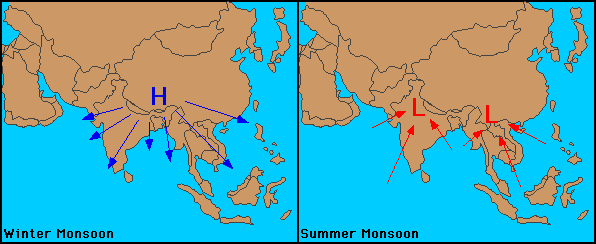
There are mainly two monsoon seasons in Singapore. The Southwest monsoon which occurs from June to September and the Northeast monsoon which occurs from December to March. During the Southwest monsoon (also known as Summer Asian Monsoon), winds blow from Australia and South-east Asia towards India. Since Singapore is located along that path of direction, the haze gets to us as well as countries like Malaysia. Refer to picture below.
Why does the haze seem worse at night?
During the day, the ground is heated by the Sun which causes the air immediately above it to become heated. When this air is warmed, it will become less dense and will rise upwards bringing along the pollutants. At night there is no sunlight to heat the ground so it cools. The air close to the ground also becomes cooler and more dense and will tend to sink together with the pollutants.
How has the haze been affecting you? Leave your comments :)
Saturday, September 09, 2006
Pluto - Dwarf Planet
Dear students,
You may have read about the recent announcement by the International Astronomical Union (IAU) to re-categorise Pluto as a dwarf planet and wondered how this information could impact your learning of the solar system in the science textbook. While you are not required to either name the planets or describe their relative positions, the current textbooks provide additional information about the planets.
The debate on the status of Pluto is an excellent opportunity for us to appreciate the role of evidence in supporting scientific theories and how advances in science continually re-define what constitutes scientific knowledge.
Some of the key points which you may find useful:
Pluto was first discovered by astronomer Clyde Tombaugh in 1930 through multiple observations of the planetary system. Advances in telescope technology and further discoveries of planetary bodies in the 21st century started the debate on the status of Pluto as a planet. The IAU on 24 Aug 06 decided to adopt a set of new rules for a planet: "a celestial body that is in orbit around the sun, has sufficient mass for its self-gravity to overcome rigid body forces so that it assumes a nearly round shape, and has cleared the neighbourhood around its orbit." In essence, the oblong orbit of Pluto that goes into Neptune’s elliptical orbital path disqualifies Pluto as one of the planets in the solar system.
You may find the following information on Pluto useful:
1. International Astronomical Union and the resolution on the definition of a planet
You may have read about the recent announcement by the International Astronomical Union (IAU) to re-categorise Pluto as a dwarf planet and wondered how this information could impact your learning of the solar system in the science textbook. While you are not required to either name the planets or describe their relative positions, the current textbooks provide additional information about the planets.
The debate on the status of Pluto is an excellent opportunity for us to appreciate the role of evidence in supporting scientific theories and how advances in science continually re-define what constitutes scientific knowledge.
Some of the key points which you may find useful:
Pluto was first discovered by astronomer Clyde Tombaugh in 1930 through multiple observations of the planetary system. Advances in telescope technology and further discoveries of planetary bodies in the 21st century started the debate on the status of Pluto as a planet. The IAU on 24 Aug 06 decided to adopt a set of new rules for a planet: "a celestial body that is in orbit around the sun, has sufficient mass for its self-gravity to overcome rigid body forces so that it assumes a nearly round shape, and has cleared the neighbourhood around its orbit." In essence, the oblong orbit of Pluto that goes into Neptune’s elliptical orbital path disqualifies Pluto as one of the planets in the solar system.
You may find the following information on Pluto useful:
1. International Astronomical Union and the resolution on the definition of a planet
http://www.cnn.com/2006/TECH/space/08/24/pluto.ap/index.html
3. It's official--Pluto's out
http://news.com.com/Images+Its+official--Plutos+out/2300-11397_3-6106240.html?tag=st.bp.story
4. Rest In peace, Pluto (Sunday Times, 27 August 2006)
5. Pluto's demotion not a cause for classroom panic
3. It's official--Pluto's out
http://news.com.com/Images+Its+official--Plutos+out/2300-11397_3-6106240.html?tag=st.bp.story
4. Rest In peace, Pluto (Sunday Times, 27 August 2006)
5. Pluto's demotion not a cause for classroom panic
http://www.cnn.com/2006/EDUCATION/08/25/pluto.reaction/index.html
6. Information about Pluto
http://en.wikipedia.org/wiki/Pluto
7. Clyde Tombaugh
http://en.wikipedia.org/wiki/Clyde_Tombaugh
6. Information about Pluto
http://en.wikipedia.org/wiki/Pluto
7. Clyde Tombaugh
http://en.wikipedia.org/wiki/Clyde_Tombaugh
Subscribe to:
Posts (Atom)